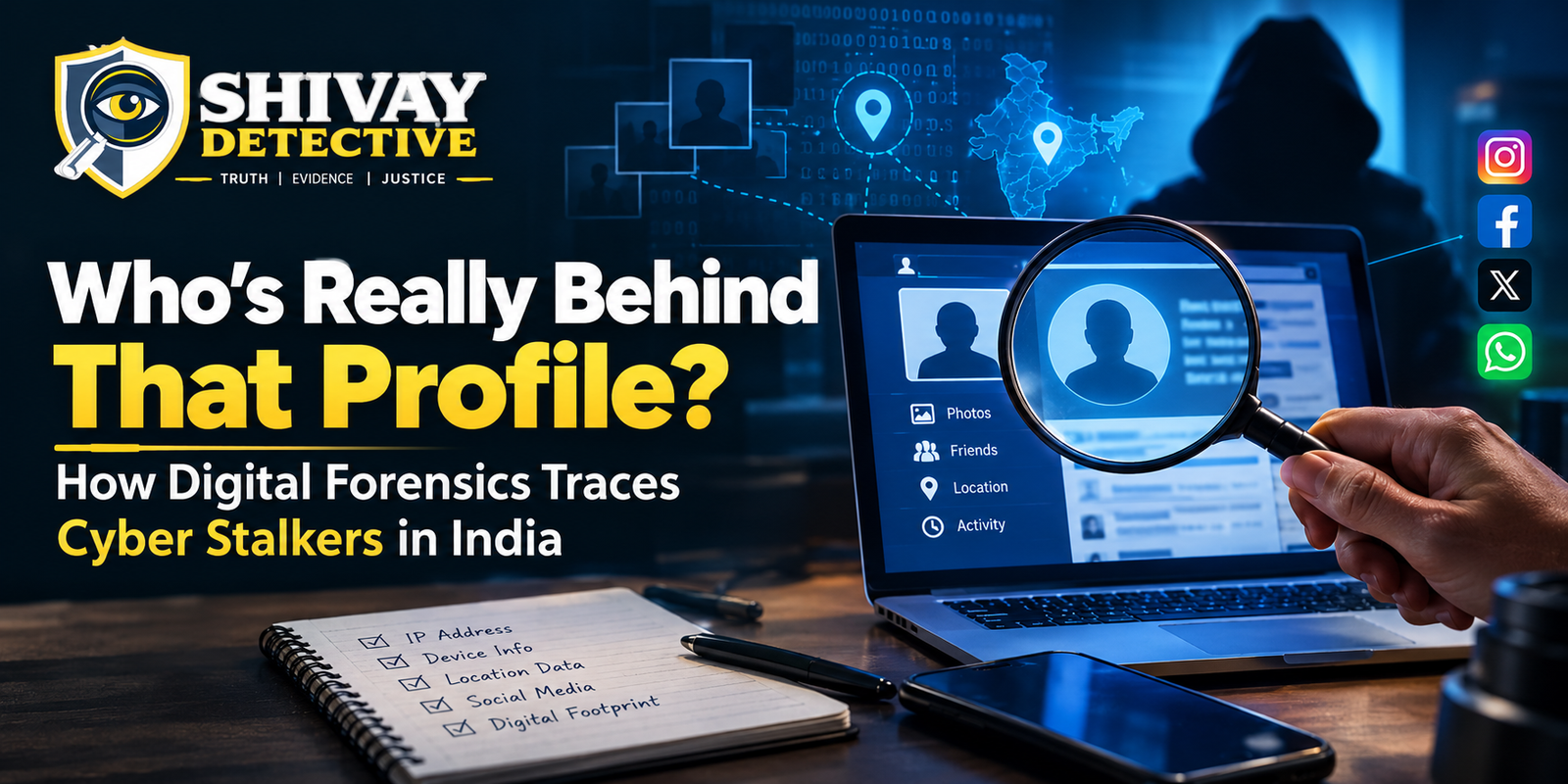
Who’s Really Behind That Profile? How Digital Forensics Traces Cyber Stalkers in India
Your phone buzzes. It’s a message from an account you have never seen. The photo looks stolen, the name is new, and the words are meant to hurt. You block it. Ten minutes later, another account appears.
Or you try to open Instagram, Facebook, or your email and find you’re locked out. Someone else is posting as you.
If this is happening to you, you are probably asking: who is doing this, and can anyone find them?
Almost nobody is truly anonymous online. Every login, message, and upload leaves a trace. Digital forensics is the science of finding those traces, protecting them, and turning them into proof a court will accept. Here is how it works, in plain language.
What Is Cyber Stalking?
Cyber stalking is the repeated use of the internet, social media, email, or messaging apps to follow, watch, threaten, or harass someone. In cyber stalking in India, we most often see:
- Fake profiles sending abusive or obsessive messages, again and again after you block them
- Impersonation, where someone copies your name and photos to contact your friends or clients
- Account hacking to read messages, steal photos, or post in your name
- Doxxing, where your number or address is posted publicly
- Sextortion, where someone threatens to leak private photos unless you pay
- Spyware secretly installed on your phone
Women are targeted more often, but men, teenagers, and business owners are affected too. It is not “just online.”
Is Cyber Stalking a Crime in India?
Yes. Confirm current section numbers with a lawyer, since India replaced its criminal laws in 2024.
- BNS Section 78: stalking, including repeatedly monitoring someone’s internet or email use
- BNS Sections 79, 351, 356: insulting a woman’s modesty, criminal intimidation, defamation
- IT Act Sections 66C, 66D, 66E: identity theft, cheating by impersonation, violation of privacy
- IT Act Sections 67 and 67A: publishing obscene or sexually explicit material
Punishment depends on the section and facts. Stalking under BNS 78 can mean jail and a fine, with harsher penalties for repeat offences. A lawyer can tell you what applies to your case.
Can You Really Trace an Anonymous Harasser?
Often, yes. A fake profile feels anonymous, but it is usually tied to real details:
- The email or phone number used to sign up
- The IP address at login, which shows the internet connection used
- Device and browser details, which can link several fake accounts
- Email headers, which show where a message really came from
- Reused photos, writing style, and online timings
This data sits with the platform (Instagram, Google, WhatsApp), with internet and telecom providers, and on devices. Our job is to connect the pieces.
VPNs, public Wi-Fi, and deleted data can make a case slower, but they rarely remove every trace. The biggest factor we see is how fast the evidence was saved.
What to Do in the First 24 Hours
- Don’t reply, confront, or delete. Replying can make things worse, and deleting destroys evidence. Mute the chat instead.
- Save evidence properly. Take full-screen screenshots showing the username, profile link, date, and time. Keep original emails (not forwards), chat exports, call logs, and any “new login” alerts. Store everything in one dated folder, backed up.
- Secure your accounts. Change passwords from a trusted device, turn on two-factor authentication, and log out of all other sessions.
- Report it with proof. See the reporting section below.
- Tell someone you trust. Stalkers rely on your silence.
How Digital Forensics Traces the Culprit: Our Process
Digital forensics means collecting, protecting, and studying electronic evidence so it can be used in an investigation or court. This is how our cyber crime investigation team works. For a wider view, read how cyber crime investigations work.
- Confidential consultation. We listen, review what you have, and tell you honestly what can be traced.
- Evidence preservation. We capture profiles, posts, and messages before they vanish, noting the source and time of each.
- Chain of custody. We record who handled each file and give it a digital fingerprint (a “hash”) to prove it was not altered. This turns a screenshot into digital evidence.
- Footprint analysis. We study account details, login records, and email headers, and look for patterns across fake accounts.
- Device examination. Mobile phone forensics can find spyware, unauthorised access, and sometimes deleted messages.
- Lawful data requests. Platforms usually release user details only to the police or a court. Our report gives your complaint the technical detail investigators need.
- Clear written report. You get a plain-language report your lawyer or the police can use.
Fake Profiles and Hacked Accounts
How to identify a fake profile: it is new, with few posts or friends. Its photos appear elsewhere (try Google Lens). Its bio is vague, and it contacts you with no mutual friends. Save the evidence first, then report it to the platform, because it may be removed within days.
Signs your account or phone is hacked: login alerts from unknown places, changed passwords or recovery details, messages you didn’t send, unknown apps, fast battery drain, or overheating.
If you want to find out who hacked your account, start here:
- Change your password and enable two-factor authentication
- Check recovery email, phone number, and email forwarding rules
- Remove unknown connected apps
- Save security emails, since they contain IP and device clues
- Don’t factory reset a phone you suspect has spyware. It erases evidence.
Naming the person usually needs platform data and a police request. We can study the login and device evidence to build the case.
How to Report Cyber Stalking in India
- cybercrime.gov.in: the official national portal for online complaints
- 1930: for financial cyber fraud, so call immediately
- Local police or cyber cell: file an FIR in person
- 112: if you feel physically unsafe
- 1091: Women’s Helpline
- StopNCII.org: helps stop the spread of intimate images
Carry printed evidence on a USB drive and a written timeline, and ask for your complaint number. If you are being blackmailed, don’t pay and don’t delete the chats. Demands usually grow after payment.
Will Digital Evidence Hold Up in Court?
Courts accept electronic evidence, but it must be proven genuine. Under the Bharatiya Sakshya Adhiniyam, electronic records generally need a Section 63 certificate, and courts check how the evidence was handled. DIY screenshots often fail because they lack dates, links, and source details. A documented forensic process makes electronic evidence admissible in court far more likely.
Mistakes That Can Ruin Your Case
- Deleting chats or accounts to “make it stop”
- Replying angrily or threatening the person
- Trying to hack the harasser back (this is a crime)
- Giving your phone to an unqualified repair shop
- Trusting “hackers for hire” who promise to track anyone instantly. Many are scams.
Common Myths
“A VPN makes someone untraceable.” A VPN adds a layer, but people slip up. They reuse emails, numbers, photos, or devices, or log in once without the VPN.
“Deleting the account removes the evidence.” Deleted content can sometimes still be found in platform records, devices, and backups, but you must act fast.
“Blocking solves it.” Blocking protects you for now, but it doesn’t stop new accounts. Evidence and reporting do.
Police or Private Investigator?
You don’t have to choose. Police and cyber cells can register an FIR, request data from platforms, and arrest. A private digital forensics investigator moves fast to preserve evidence, examines your devices, and prepares a technical report to strengthen your complaint. Read more in private investigator vs police investigation.
We handle cyber stalking, fake profiles, hacked accounts, sextortion, spyware checks, and corporate cases like data theft and brand impersonation across India, including Pune (confirm cities you serve). If you’re worried about your child online, our teenage monitoring service can help you find out what’s happening, discreetly.
We work only within the law, never guarantee results, and never break into anyone’s account.
Don’t Face This Alone
Cyber stalking is meant to make you feel small and scared. You are not alone, and anonymous accounts leave more traces than their owners think. If you are being harassed, impersonated, or hacked, contact us for a confidential discussion. We’ll tell you honestly what is possible and help you take the next step.
Frequently Asked Questions
Can you find out who hacked your Instagram or Facebook account?
Sometimes. Login alerts, IP records, and device details give strong leads. Naming the person usually needs data from the platform and internet providers through a police complaint.
Can an anonymous harasser be traced in India?
Often yes. When evidence is saved early and the case goes through legal channels, many fake accounts can be linked to a real connection or device.
What is the punishment for cyber stalking in India?
Stalking under BNS Section 78 can lead to imprisonment and a fine, with a higher penalty for repeat offences. Other BNS and IT Act sections may also apply.
Is a screenshot enough evidence?
Rarely on its own. Add profile links, dates, original files, email headers, and a Section 63 certificate.
Can I trace someone myself using an IP address?
No. An IP address alone doesn’t reveal a name or address. Only the internet provider holds that, and it is released through legal channels.
Can a private detective do this legally?
Yes, when working within the law. A genuine investigator preserves and analyses evidence and supports your complaint. They do not hack accounts or access private data illegally.