
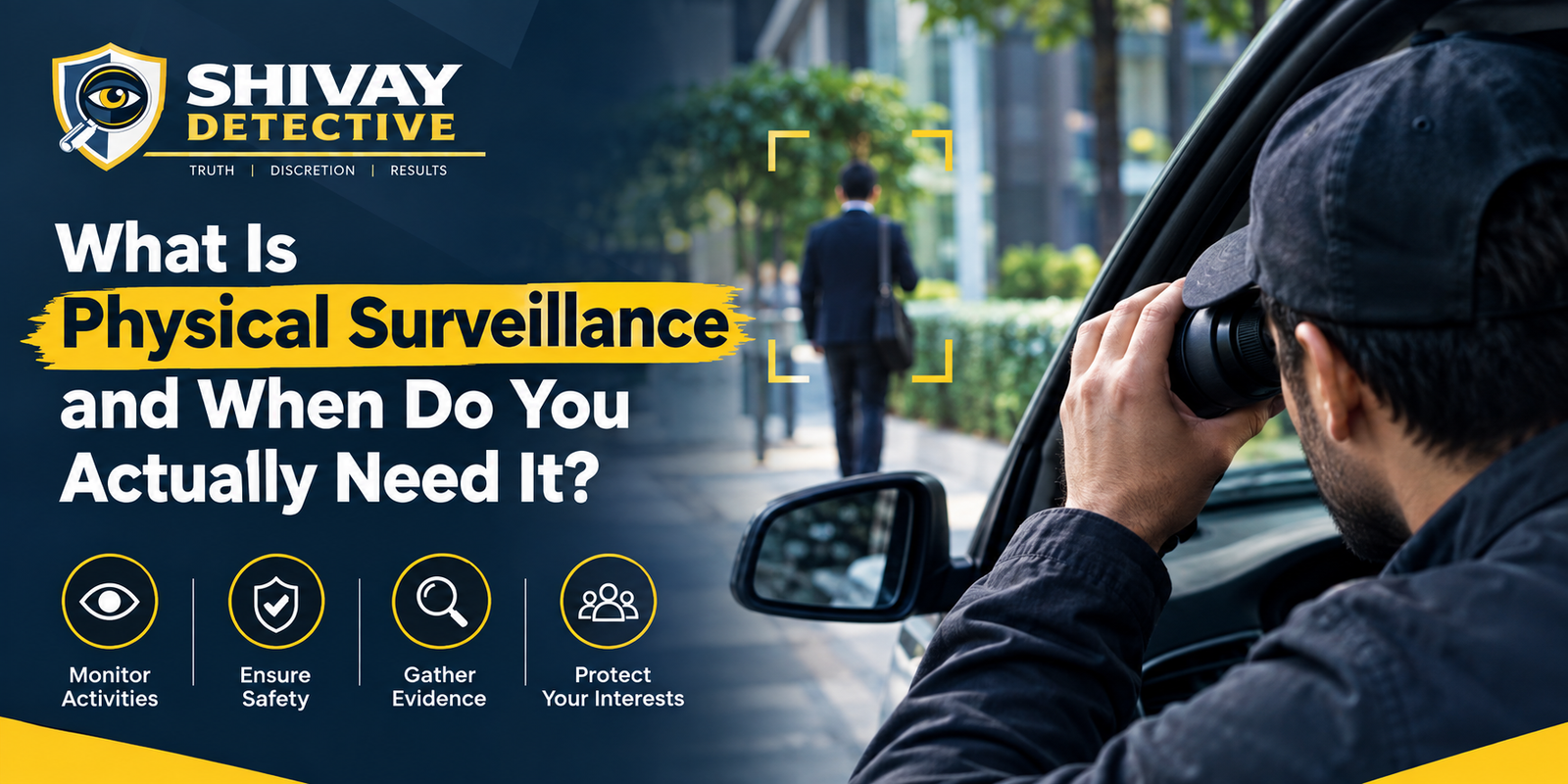
What Is Physical Surveillance and When Do You Actually Need It?
Most people picture CCTV cameras or a hidden lens when they ask what is surveillance. But some situations need something more human. Physical surveillance is the discreet, in-person observation of a person, vehicle or place by trained investigators, carried out to document what actually happens rather than what someone claims.
This guide explains how physical surveillance works day to day, where the legal boundaries sit, and when it is genuinely worth paying for.
What Is Physical Surveillance?
Physical surveillance is the in-person, real-time observation and documentation of a person’s activities, behaviour or movements by a trained investigator or security specialist. It is a form of covert surveillance: operatives watch a subject directly and record what they see through notes, photos and video, with no reliance on a phone, an app or an online account. It depends on trained people, careful planning and patience.
There are two main formats:
- Mobile surveillance (tailing): following a subject on foot or by vehicle as they move between locations.
- Static surveillance (a stakeout): watching a fixed location, entrance or perimeter from a discreet, stationary post.
It also differs from routine monitoring. In the monitoring vs surveillance question, monitoring is usually ongoing and general, like a shop’s CCTV. Surveillance is targeted and time-bound, aimed at a specific person or a specific question.
Among the common types of surveillance, physical surveillance sits alongside electronic methods such as fixed video surveillance. A camera watches one spot. A trained person can adapt to a moving target in public spaces, following a subject into a market, a metro station or a building lobby in ways a fixed camera never could.
How Physical Surveillance Works Day to Day
A real surveillance investigation looks nothing like the movies. Most of it is preparation and waiting.
- Briefing and planning. The team confirms the objective and studies the subject’s routine, address, vehicle and likely routes. A clear goal prevents wasted hours.
- Choosing the method. Depending on the subject, the team selects a stakeout, foot surveillance or vehicle tailing. Mobile surveillance usually uses more than one car so no single vehicle is noticed.
- Fieldwork. A small surveillance team rotates positions and hands the subject over between members. Investigators avoid contact, and nothing is staged or provoked.
- Documentation. Every observation is logged with time, place and behaviour, backed by time-stamped photos or video.
- Reporting. The client receives a structured surveillance report that is factual, dated and easy to follow.
Is It Legal? Understanding the Boundaries
Observing someone in a public place is generally not an offence. Problems begin when observation turns into harassment, intrusion or unlawful recording. Because many of our readers are in India, here is the picture there.
- Hiring is legal, but the work is still bound by general law. India has no central law that licenses private investigators (a regulation bill has been pending since 2007), so every investigator must stay within existing criminal and privacy law.
- Stalking is an offence. Section 78 of the Bharatiya Nyaya Sanhita covers repeatedly following a woman and contacting her despite clear disinterest, or monitoring her online communication. A first conviction can mean up to three years in prison.
- Privacy is a fundamental right. The Supreme Court recognised this in the Puttaswamy judgment. Entering private property, bugging phones, hacking accounts or recording in private spaces is unlawful, whatever the reason.
- How evidence is collected matters. Material gathered unlawfully can damage a case, and electronic records need proper certification under the Bharatiya Sakshya Adhiniyam.
This is general information, not legal advice. For a specific situation, speak to a lawyer.
When Do You Actually Need Physical Surveillance?
It is not the answer to every problem. It makes sense when the truth cannot be established through documents, records or a direct conversation.
- Personal safety. If you are being harassed or followed and do not know by whom, physical surveillance can identify the person and document a pattern that supports a police complaint.
- Tracking a subject. Confirming where a person lives, works or spends their time, for example when they have gone silent during a dispute or a legal process.
- Matrimonial doubts. Verifying a partner’s daily routine when infidelity is suspected and conversation has not settled it.
- Child custody disputes. Checking a child’s safety, living conditions or wellbeing when neglect is suspected.
- Fraud and legal cases. First-hand visual evidence for insurance claims, personal injury suits or suspected dishonesty, such as an activity level that does not match the injury claimed.
- Employee investigations. Fake sick leave, moonlighting for a competitor, or substance abuse during work hours.
- Corporate security. Detecting corporate espionage, or tracing the source of property theft and misuse of company assets.
If a background check, public record or simple conversation can answer your question, start there. It costs far less.
How to Choose the Right Provider
If you decide to hire a private investigator, look at how the work is done, not just the price. A trustworthy private investigation agency will offer a written scope, a confidentiality agreement, clear timelines, a sample report and transparent charges. Ask what private investigator services they will not provide.
Be wary of any private detective company that promises call records, bank statements or phone tapping. Those are illegal routes, and a reputable firm declines them. You can read more about our approach on our physical surveillance services page.
Final Thoughts
Physical surveillance is a precise tool. Used lawfully and for the right reasons, it replaces suspicion with facts. If you are weighing it up, define exactly what you need to know first, then speak to a transparent, experienced professional. When you’re ready, contact our team for a confidential discussion about whether it is the right fit.
Frequently Asked Questions
Is it legal to follow someone?
Following someone in a public place is not automatically illegal, but context decides. Repeated following that frightens a person, or continues after they have made clear they are not interested, can amount to stalking. Trespass and unlawful recording are separate offences. Professional investigators stay in public spaces, avoid contact and keep to a defined purpose.
How long does surveillance take?
It depends on the objective and the subject’s routine. Some assignments produce answers in one or two days, while others need a week or more, especially when the pattern is irregular. A good agency gives a realistic estimate and reviews progress after the first session instead of promising a fixed result.
What evidence can a PI collect?
Time-stamped photos and video taken in public places, written logs of movements, vehicle and location details, observed meetings and a final report. A lawful investigator cannot supply phone records, bank statements or anything obtained through hacking or trespass. Whether evidence is accepted in court also depends on how it was gathered and presented.
How do private investigators follow someone?
They rely on planning and teamwork more than tricks. Investigators study the subject’s routine, use several people and vehicles, rotate roles, keep a safe distance and blend into their surroundings. Depending on the situation, they combine foot, mobile and static observation.
How to tell if you're being followed?
Watch for the same person or vehicle appearing in different places, or someone who changes direction when you do. Vary your route, stop somewhere busy and well lit, and head into a shop or towards a police station. Do not confront anyone. Note descriptions, number plates and times, and report it to the police. If you feel in danger, call 112.
Is physical surveillance better than GPS tracking?
They do different jobs. GPS shows where a vehicle is, but not who is driving or what happens on arrival, and tracking another person without consent can create legal and privacy problems. Physical surveillance shows who, what and with whom, giving context that a dot on a map cannot. For your own assets, such as company vehicles, GPS is simple and cost-effective.
What is the difference between legal surveillance and stalking?
Purpose and conduct. Legal surveillance has a legitimate reason, such as gathering evidence for a claim or protecting safety, stays in public places, avoids contact and is documented. Stalking is repeated, unwanted attention meant to intimidate or control, often continuing after clear disinterest. If the person being watched is being frightened, the line has been crossed.